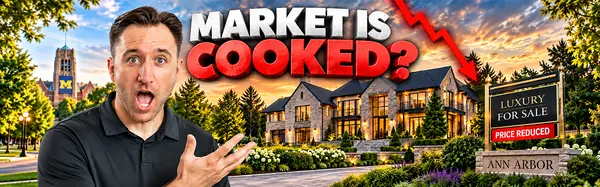
The Truth About Living in Ann Arbor, Michigan (2026 Relocation Guide)
Ann Arbor, Michigan consistently ranks as one of the best places to live in the entire United States. On paper, it checks every box: a recession-resilient economy, top-rated public schools, a vibrant culture, and over 162 public parks.
However, moving here without understanding how the local housing market actually operates leads many out-of-state buyers to make costly mistakes. From unexpected property tax resets to intense downtown construction density and hyper-local neighborhood price shifts, there are critical factors you need to know before making a move.
Having relocated back to Michigan after living in California, my team and I have spent over a decade guiding families through Ann Arbor and its surrounding suburbs. Here is the unvarnished truth about living in Ann Arbor in 2026—the three reasons people fall in love with it, and the three hidden traps that catch relocators off guard.
⚡ Quick Takeaways (TL;DR)
-
An Economic Fortress: Driven by the University of Michigan and U-M Health (highlighted by the $920 million, 12-story D. Dan and Betty Kahn Health Care Pavilion adding 1,000 new healthcare jobs), Ann Arbor's housing market is exceptionally insulated against national economic downturns.
-
Top-Tier Schools & Value Shield: A-rated public schools drive steady buyer demand year-round, protecting long-term home equity across all major attendance zones.
-
162+ Parks & Walkability: The city mandates green space allocation for new developments, creating a highly outdoor-focused community anchored by a walkable downtown grid.
-
The Property Tax Uncapping Trap: Online estimates (Zillow/Redfin) often show historical taxes around $5,800/yr. In reality, Michigan property taxes uncap upon sale, resetting a $600,000 home’s tax bill to roughly $13,000/year (at Ann Arbor's ~53 millage rate).
-
Downtown Construction & Zoning Shifts: Recent zoning updates allowing developments over seven stories have turned the downtown and campus corridors into a high-density construction zone, while residential neighborhoods like Burns Park, Water Hill, and Arbor Hills remain quiet and untouched.
-
The "Ann Arbor Orbit" Alternative: Buyers seeking lower taxes, larger lots, and quieter streets often choose nearby feeder towns like Saline, Dexter, Brighton, Chelsea, and Howell.
Watch: The Truth About Living in Ann Arbor, Michigan (2026)
At-a-Glance: Living in Ann Arbor Snapshot
| Market / Living Factor | Ann Arbor Proper | The "Ann Arbor Orbit" (Saline, Dexter, Brighton) |
| Median Single-Family Home Price | $580,000 – $620,000+ | $450,000 – $560,000 |
| Property Tax Millage Rate | ~53 Mills (Effective ~$13k/yr on $500k purchase) | ~32 – 42 Mills (Significantly lower effective tax) |
| Downtown Environment | High density, urban walkability, active construction | Historic small-town main streets, easy parking |
| Lot Footprints | 0.15 – 0.25 acres standard city lots | 0.50 – 2.0+ acres private suburban/wooded lots |
| Primary Economic Drivers | U-M Campus, Michigan Medicine, Tech Hubs | Commuter bedroom towns into Ann Arbor core |
3 Reasons People Fall in Love with Ann Arbor
1. Unmatched Economic Stability
When buying a home, you are investing in the surrounding local economy. Ann Arbor is arguably the most economically insulated city in the Midwest.
The city is anchored by the University of Michigan and Michigan Medicine (which employs over 30,000 people and recently expanded with the $920 million Kahn Pavilion, bringing 1,000 additional medical jobs to town). Alongside Trinity Health and the VA Health System, this massive healthcare and research foundation keeps local home values steady even during broader national housing corrections.
2. A-Rated Public Schools Protect Your Equity
Ann Arbor Public Schools consistently earn A+ ratings on platforms like GreatSchools.org and Niche.com. Families move here specifically for educational opportunities, creating sustained, multi-generational demand for housing across all price tiers. This consistent demand acts as a protective shield for your equity.
🎥 Tour Ann Arbor Neighborhoods on YouTube
Watch driving tours, school breakdowns, and honest pros & cons of living in Ann Arbor and Washtenaw County on Eric's YouTube channel.
Subscribe to Eric's YouTube Channel →3. Exceptional Walkability & 162+ Parks
Ann Arbor is designed for outdoor living. The city maintains over 162 public parks and mandates green space designations within new residential developments. You can walk from historic neighborhoods to independent coffee shops, farm-to-table restaurants, the Kerrytown Farmers Market, and the Huron River trail network without touching your car keys.
3 Hidden Realities That Out-of-State Buyers Regret
1. The Property Tax Uncapping Trap
This is the single biggest financial surprise for relocators. When browsing listing portals like Zillow or Redfin, the displayed property tax reflects what the current owner pays.
Under Michigan law, property taxes uncap upon transfer of ownership. The taxable value resets to approximately 50% of the home's new purchase price.
-
The Online Myth: A portal shows annual taxes of $5,800 on a $500,000 listing.
-
The 2026 Reality: The home sells for $500,000. The State Equalized Value (SEV) resets to $250,000. Multiplying $250k by Ann Arbor’s ~53 millage rate results in an actual property tax bill of roughly $13,000 per year.
-
Impact: Failing to calculate this uncapped tax adjustment before submitting an offer can unexpectedly add $600+ to your monthly mortgage payment.
2. Downtown Construction & Density Shifts
For years, Ann Arbor strictly limited building heights downtown to seven stories. Recent zoning changes removed those height caps to increase housing density, leading to significant high-rise, hospital, and university construction around campus and the downtown grid.
While residential pockets like Burns Park, Water Hill, and Arbor Hills remain quiet single-family havens, driving through the downtown core involves navigating frequent detours, road closures, and construction cranes.
3. Hyper-Local Market Micro-Pockets & Off-Market Sales
Ann Arbor does not operate as a single, uniform real estate market.
In luxury enclaves over $1.5 million, many high-end properties sell as off-market pocket listings before hitting public MLS channels. Meanwhile, other price bands experience varying days on market depending on school boundaries and architectural style. Treating Ann Arbor with a "one-size-fits-all" bidding strategy often results in overpaying or repeatedly losing out in competitive situations.
The Alternative: Exploring the "Ann Arbor Orbit"
If you love Ann Arbor's cultural amenities, hospital care, and dining, but want lower property tax rates, larger private lots, and a quieter suburban atmosphere, consider the feeder communities surrounding the city:
-
Saline: Located 15 minutes south; offers matching school ratings, larger homes (2,300+ sq ft), and bigger lot footprints for the same dollar amount.
-
Dexter: Positioned along the Huron River 15 minutes northwest; features a picturesque riverfront downtown grid and a highly rated school system.
-
Brighton: Located 20 minutes north in Livingston County; offers lower township tax millages, all-sports lakes, expansive acreage, and major commercial conveniences.
-
Chelsea: Situated 20 minutes west; known for a historic downtown, cultural theater scene, and peaceful countryside surroundings.
Frequently Asked Questions (FAQs)
How are Michigan property taxes calculated after buying a home in Ann Arbor?
Property taxes uncap upon purchase. Multiply your estimated purchase price by 0.50 to determine the new Taxable Value, then multiply that figure by Ann Arbor's millage rate (~0.053) to estimate your post-closing annual property tax bill.
What is the median home price in Ann Arbor in 2026?
The median price for a single-family home in Ann Arbor ranges from $580,000 to $620,000+, while condos trade lower. Price per square foot averages around $330/sq ft within city limits.
What are the best suburbs near Ann Arbor for lower property taxes?
Communities in surrounding townships—such as Saline, Dexter, Lodi Township, Genoa Township (Brighton), and Scio Township—offer significantly lower property tax millages while keeping you within 15 to 20 minutes of downtown Ann Arbor.
Final Verdict: Is Ann Arbor Right for You?
If you prioritize urban walkability, top-tier healthcare access, vibrant university energy, and A+ public schools—and your budget accommodates higher property tax millages—Ann Arbor is one of the best places to live in the nation.
However, if you prefer larger yards, lower taxes, and quiet suburban streets, exploring the Ann Arbor Orbit feeder towns may give you the lifestyle you want while saving you money every month.
Ready to find the ideal neighborhood in Washtenaw County?
Schedule a private 1-on-1 Zoom strategy session with Eric Meldrum. We'll help you compare submarkets, evaluate schools, and plan your relocation seamlessy.
Schedule Your Relocation Zoom Call →Categories
- All Blogs (89)
- Ann Arbor (26)
- Ann Arbor Market Updates (5)
- Ann Arbor Orbit (3)
- Best Metro Detroit Suburbs (5)
- Best Places to Live in Michigan (1)
- Birmingham (1)
- Brighton (7)
- Brush Park (1)
- Buying in Detroit (2)
- Buying in Michigan (1)
- Chelsea (1)
- City Spotlights (1)
- Cost of Living (1)
- Detroit News (1)
- Detroit Pros and Cons (3)
- Events (4)
- Food & Lifestyle (2)
- Grosse Pointe (1)
- Lake Life (2)
- Lifestyle & Community (6)
- Living in Detroit (14)
- Living in Metro Detroit (5)
- Living in Michigan (20)
- Luxury Real Estate (6)
- Market Insights (8)
- Michigan News (4)
- Michigan Real Estate Trends (11)
- Moving to Ann Arbor (8)
- Moving to Metro Detroit (3)
- Moving to Michigan (17)
- Neighborhood Comparisons (1)
- Neighborhood Guide (8)
- Plymouth (1)
- Property Listing (1)
- Quality of Life (2)
- Real Estate Trends 2026 (2)
- Relocation Guide (18)
- Relocation Tips (40)
- Saline (1)
- Southeast Michigan (1)
- Washtenaw County (1)
- Wealthiest Neighborhoods (1)
- West Side Suburbs (1)
Recent Posts