
What Salary Do You Actually Need to Live Comfortably in Metro Detroit? (2026 Breakdown)
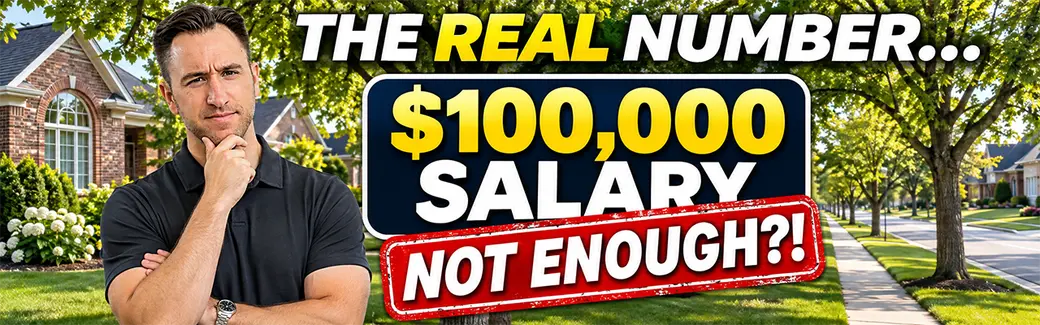
If you type "cost of living in Metro Detroit" into an online national calculator, the numbers look almost too good to be true. Broad regional datasets often cite an overall Southeast Michigan median home sale price around $283,000 and suggest a family of four can cover baseline expenses on roughly $89,000 to $110,000 a year.
Here is the problem: those averages blend distressed urban zip codes with A+ suburban school districts.
If you are relocating to Metro Detroit with your family and targeting top-rated communities like Northville, Plymouth, Novi, Canton, South Lyon, or Birmingham, a $283,000 budget won't get you into a move-in-ready single-family home. Furthermore, national calculators consistently miss three Michigan-specific monthly expenses—uncapped property taxes, No-Fault auto insurance, and winter heating bills—that can swing your monthly budget by $800 to $1,500.
Using late-2026 mortgage interest rates (~7.11%–7.26% for a 30-year fixed loan) and the standard 28/36 qualifying rule, here is the exact annual household salary you need to live comfortably across Metro Detroit’s three primary suburban tiers.
⚡ Quick Takeaways (TL;DR)
-
The Baseline Reality: While national living-wage models peg basic survival for a two-income family of four in Metro Detroit at roughly $110,000/year, buying a single-family home in an A+ school district requires substantially more.
-
Tier 1 Suburbs ($425K Home — Canton, South Lyon, Farmington Hills): Requires a gross household income of ~$131,000 to $145,000/year (assuming 20% down).
-
Tier 2 Suburbs ($625K Home — Plymouth, Novi, Rochester Hills): Requires a gross household income of ~$193,000 to $210,000/year.
-
Tier 3 Suburbs ($950K Home — Birmingham, Northville, Bloomfield Twp): Requires a gross household income of ~$296,000 to $320,000/year.
-
The Three "Hidden" Budget Multipliers: Michigan's Proposal A property tax uncapping, auto insurance rates (averaging ~$2,170 to $2,700/year statewide, though much lower in outer suburbs than in Detroit proper), and DTE winter heating spikes must be factored in before you make an offer.
At-a-Glance: The 3 Metro Detroit Suburban Salary Tiers (2026)
To calculate true comfort—not being "house poor"—lenders and financial planners use the 28/36 Rule: your total housing payment (Principal, Interest, Taxes, and Insurance) should not exceed 28% of your gross monthly income, and total debt (including car loans and student debt) should stay under 36%.
The table below assumes a 20% down payment, a 7.125% 30-year fixed mortgage rate, and post-closing uncapped Michigan property taxes:
| Suburban Tier | Target Communities | Typical Home Price | Est. Monthly PITI Payment | Gross Salary Needed (28% Rule) | Comfortable Household Income |
| Tier 1: Family Value & Growth | Canton, South Lyon, Farmington Hills | $425,000 | ~$3,046 / mo | $130,500 / yr | $135,000 – $150,000+ |
| Tier 2: Premier Academic Hubs | Plymouth, Novi, Rochester Hills | $625,000 | ~$4,498 / mo | $192,800 / yr | $200,000 – $225,000+ |
| Tier 3: Luxury & Walkable Cores | Birmingham, Northville, Bloomfield Twp | $950,000 | ~$6,918 / mo | $296,500 / yr | $310,000 – $350,000+ |
Breaking Down the 3 Suburban Tiers
Tier 1: The $135K–$150K Household Income Bracket ($425K Home)
-
Where You Land: Canton, South Lyon, Livonia, or Farmington Hills.
-
What Your Money Buys: A solid 3-to-4-bedroom colonial or ranch (1,900–2,300 sq. ft.) with an attached two-car garage, a full basement, and access to strong public school districts like Plymouth-Canton or South Lyon Community Schools.
-
The Monthly Math: With $85,000 down (20%), your $340,000 mortgage runs roughly $2,291/mo in principal and interest. Add ~$620/mo for uncapped township property taxes and ~$135/mo for homeowners insurance, bringing your all-in housing cost to $3,046/mo. At a $140,000 household salary, you still have plenty of room for childcare, groceries, and retirement contributions.
Tier 2: The $200K–$225K Household Income Bracket ($625K Home)
-
Where You Land: Novi, Plymouth, Rochester Hills, or Brighton.
-
What Your Money Buys: This is the sweet spot for dual-income corporate transferees, engineers, and healthcare professionals. A $625,000 budget secures a 2,600-to-3,200-square-foot home in a master-planned subdivision with a 3-car garage, updated kitchen, finished daylight basement, and A+ school rankings.
-
The Monthly Math: With $125,000 down, your $500,000 loan runs $3,369/mo in principal and interest, plus ~$964/mo in uncapped taxes and ~$165/mo in insurance ($4,498/mo total PITI). You need roughly $193,000/yr just to satisfy the 28% front-end ratio cleanly.
Tier 3: The $310K+ Household Income Bracket ($950K+ Home)
-
Where You Land: Birmingham, Northville, Bloomfield Township, or Grosse Pointe Farms.
-
What Your Money Buys: Walkable historic downtown living, luxury new-construction infill, or multi-acre wooded privacy. (Notably, a $760,000 loan after 20% down on a $950,000 purchase stays right below the $832,750 conforming loan limit, helping you avoid higher jumbo interest rates.)
-
The Monthly Math: Principal and interest sit at $5,120/mo, while higher municipal millages push uncapped property taxes to roughly $1,583/mo ($19,000/yr). Combined with ~$215/mo for insurance, your monthly housing commitment hits $6,918/mo, requiring a minimum gross household income of ~$296,500/year.
3 Michigan-Specific Expenses Online Calculators Miss
When relocating from states like Texas, California, or Illinois, your paycheck goes much further on housing—but three local cost factors catch newcomers off guard:
1. Proposal A Property Tax Uncapping
Never build your budget using the property tax number displayed on Zillow or Realtor.com. Under Michigan's Proposal A, property taxes are capped for as long as the current owner lives there. The year after you buy, the taxes uncap and reset to roughly 50% of your purchase price multiplied by the local millage rate. Buying a home from a 20-year owner can cause the annual tax bill to double overnight.
2. Michigan No-Fault Auto Insurance (The Zip Code Effect)
Michigan drivers pay an average of $2,170 to $2,700 per year ($181 to $225/month) for auto insurance—roughly 25% higher than the national average due to state No-Fault Personal Injury Protection (PIP) laws. However, rates vary wildly by zip code: full-coverage policies inside Detroit proper average over $418/month, whereas outer suburbs like Rochester, Ann Arbor, and Brighton average $210 to $230/month per vehicle.
3. Winter DTE Heating & Electric Bills
While summer cooling bills are mild compared to Texas or Arizona, January and February furnace runs push combined gas and electric utility bills (DTE Energy / Consumers Energy) to $250 to $350/month for a 2,500-square-foot single-family home.
Frequently Asked Questions (FAQs)
Is $100,000 a good salary in Metro Detroit?
For a single individual or a couple renting an apartment ($1,400–$1,800/month), a $100,000 salary provides a very comfortable lifestyle in Metro Detroit. However, for a family of four looking to buy a single-family home in a top-rated school district, $100,000 will feel tight once uncapped property taxes, childcare, and Michigan auto insurance are factored in.
Which Metro Detroit suburbs give you the most house for your salary?
Communities like Canton, South Lyon, Howell, and Chesterfield Township deliver the highest square-footage-per-dollar in Southeast Michigan, allowing buyers to secure modern 4-bedroom colonials with full basements in the $425,000 to $525,000 range.
How can I lower my monthly housing payment when moving to Michigan?
Focus on charter townships rather than incorporated cities. Living in Northville Township, Plymouth Township, or Genoa Township (Brighton) often gives you the exact same A+ school district as the neighboring city while reducing your annual property tax millage rate by 20% to 35%.
Metro Detroit remains one of the best financial arbitrage plays in the country—especially if you are relocating from a high-cost coastal market. By matching your household income to the right suburban tier and calculating uncapped property taxes up front, you can upgrade your home's square footage without stretching your monthly cash flow.
Planning a Move to Metro Detroit?
Schedule a private 1-on-1 Zoom strategy session with Eric Meldrum. We'll map out target subdivisions, evaluate HOA amenities, and compare commute times in real time.
Schedule Your Zoom Strategy Call →Categories
- All Blogs (108)
- Ann Arbor (32)
- Ann Arbor Market Updates (6)
- Ann Arbor Orbit (5)
- Best Metro Detroit Suburbs (7)
- Best Places to Live in Michigan (1)
- Birmingham (1)
- Brighton (11)
- Brush Park (1)
- Buying in Detroit (3)
- Buying in Michigan (1)
- Chelsea (1)
- City Spotlights (1)
- Cost of Living (3)
- Detroit News (2)
- Detroit Pros and Cons (3)
- Events (4)
- Food & Lifestyle (2)
- Grosse Pointe (1)
- Howell (2)
- Lake Life (4)
- Lakefront Real Estate (2)
- Lifestyle & Community (8)
- Living in Detroit (14)
- Living in Metro Detroit (7)
- Living in Michigan (20)
- Luxury Real Estate (7)
- Market Insights (8)
- Michigan News (4)
- Michigan Real Estate Trends (14)
- Moving to Ann Arbor (13)
- Moving to Metro Detroit (7)
- Moving to Michigan (21)
- Neighborhood Comparisons (1)
- Neighborhood Guide (8)
- Plymouth (1)
- Property Listing (1)
- Quality of Life (2)
- Real Estate Trends 2026 (2)
- Relocation Guide (25)
- Relocation Tips (40)
- Saline (1)
- Southeast Michigan (1)
- Washtenaw County (1)
- Wealthiest Neighborhoods (4)
- West Side Suburbs (1)
Recent Posts